
Business Education (Bachelor Degree)
The undergraduate program of Business Education is a multi-entry study program, accepting students graduated from high schools, Madrasah Aliyah (Islamic High Schools), vocational high schools, or equivalent graduates. The curriculum uses the semester credit system and has a maximum load of 147 credits. The credits in the curriculum follows the provisions of the KKNI, the National Higher Education Standards (SN-DIKTI) through Regulation of the Minister of Research, Technology, and Higher Education Number 44 of 2015. In addition, it is guided by the Guidelines for Preparation of Higher Education Curriculum (KPT) 2016, Guidelines for the Development of the 2016 Teacher Education Curriculum (KPG), Guidelines for Preparing Learning Outcomes for Graduates (2014), and Academic Senate Regulation Number 002/SENAT AKD./UPI- HK/VI/2018 on the Guidelines for Curriculum Development of UPI.
The courses offered in the Business Education Study Program consist of:
(1) General Courses (MKU) 7 Courses (14 credits); (2) Field Practice Courses (MKPPL) 1 Course (4 credits); (3) University-Based Professional Courses (MKKU) 4 Courses (8 credits); (4) Faculty-Based Professional Courses (MKKF) 2 Courses (6 credits); (5) Study Program-Based Core Professional Courses (MKKIPS) 4 Courses (12 credits); (6) Study Program-Based Elective Professional Courses (MKKPPS) 29 Courses (85 credits); (7) Study Program-Based Instructional Skill Courses (MKKPPS) 6 Courses (18 credits). The distribution of courses in each semester can be seen in the curriculum structure (attached curriculum structure). Teaching and research are closely related. Teaching and research are part of the three pillars of higher education, where teaching can be used as material for research studies and the results are used to improve the teaching process. In the research, students are included according to the research umbrella of the lecturer.
The curriculum of the Study Program is based on the KKNI at level 6. The scope of learning outcomes for graduates consists of attitudes, knowledge, general skills, and special skills (learning outcomes are attached). Accordingly, learning outcomes of the Business Education Study Program include:
a. Demonstrating scientific, educational, and religious attitudes and behavior, which contribute to improving the quality of life in society, nation, and state- based on academic norms and ethics.
b. Mastering the concept of business education based on business edupreneur in accordance with the demands of the industrial revolution era 4.0
c. Mastering the concept of business learning that is in accordance with the demands of the 4.0 industrial revolution era
d. Mastering business learning materials that are in accordance with the demands of the 4.0 industrial revolution era
e. Mastering data literacy in accordance with the demands of his professional duties in the era of the industrial revolution 4.0
f. Integrating study and innovation skills, mastery of technology and information, career development, and life skills to become lifelong learnersApplying logical, critical, systematic, and innovative thinking in the context of developing or implementing science and technology that pays attention to and applies humanities values in accordance with their field of expertise.
g. Applying the concept of business learning that is in accordance with the demands of the industrial revolution era 4.0
h. Designing business learning materials in accordance with the demands of the industrial revolution 4.0 era
i. Utilizing and solving problems based on data literacy in accordance with the demands of his professional duties in the era of the industrial revolution 4.0
j. Assessing and applying business opportunities
k. Utilizing the concept of Business Education in community empowerment.
The study program prepares an ideal plan for the lecture process so that students can graduate on time in 8 semesters with a maximum credit load of 147 credits (see Figure 3.1.6 and 3.1.7). In total, when converted to ECTS, the credits that students take are 233.44 ECTS, with an average credits per semester of 18.38 credits (18.38 x (39.7 / 25) = 29.19 ECTS). In semester 1, 2, 3 and 5 students take 21 credits (39.7:25 x 21 credits = 33.35 ECTS); in semester 4, 6 and 7, students take 19 credits (39.7:25 x 19 credits = 30.17 ECTS) and in semester 8, they take 6 credits (39.7:25 x 6 credits = 9.53 ECTS).

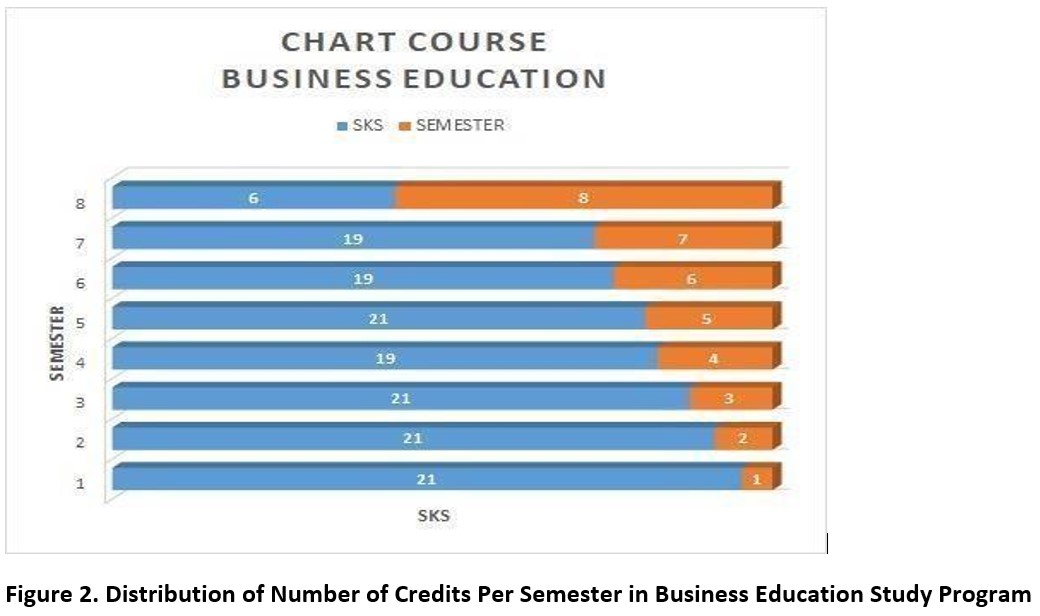
In the curriculum structure of the undergraduate level of Business Education Study Program, of the 147 credits in the Study Program, 129 credits are compulsory elements and 18 of them are elective courses, which students can take starting from the 5th semester. However, it is mandatory to choose six courses in one concentration. The Business Education Study Program provides a group of elective Courses/specializations/concentrations, namely:
a. Entrepreneurship, 6 courses (18 credits)
b. Retail business, 6 courses (18 credits)
c. Human Resource Management, 6 courses (18 credits)
d. Marketing Management, 6 courses (18 credits)
e. Digital Business, 6 courses (18 credits)
f. Digital Marketing, 6 courses (18 credits)
g. Financial Technology, 6 courses (18 credits)
h. Digital Business Education, 6 courses (18 credits).
Moreover, the Business Education Study Program has exclusive courses offered to students of other study programs at FPEB. They are Business Introduction courses (3 credits) and Entrepreneurship courses (3 credits).
The study program also offers MBKM related activities. The activities can be carried out as an outbound and inbound. They consist of: (1) Internships or work practices, (2) Projects in villages, (3) student exchanges, (4) Research, (5) Entrepreneurship, (6) Independent studies, (7) Humanitarian projects, and (8) Teaching in schools. These activities can be managed by the study program or under the coordination of relevant directorates in UPI. The following courses are offered to non UPI students.
Table 1. MBKM Courses offered in Business Education Study Program
|
Codes |
Courses |
Credits |
|
MB533 |
Consumer behavior |
3 |
|
MB542 |
Digital Age Entrepreneurship |
3 |
|
MB543 |
New Ventura Creation |
3 |
|
MB551 |
Business Leadership |
3 |
|
MB571 |
Social Media Marketing |
3 |
|
MB585 |
Digital Finance |
3 |
|
MB534 |
Brand Strategy Management |
3 |
The development of teaching materials is needed to meet the demands of the curriculum and competency standards required by the Indonesian National Qualifications Framework (KKNI) and improve the cognitive, affective, and psychomotor domains of students. The process of updating the curriculum in the Study Program is carried out annually in line with the curriculum evaluation activities carried out in the Study Program. Teaching material development activities are carried out independently or in teams based on the same field of study. The process of developing teaching materials is carried out by considering the demands of the curriculum, the characteristics of the targets, the demands for problem-solving, industrial developments, the latest studies. Teaching materials are updated regularly in the form of textbooks, modules, and handbooks.
Learning outcomes in the Study Program have been adjusted to the Graduate Profile of UPI. It produces Teacher Candidates (People who have the competence to educate, teach, guide, a direct, train, assess, evaluate, and develop education and learning), Educational Research Assistant (people who have the competence to assist in identifying educational problems, finding solutions through scientific procedures, and publishing and disseminating research results), and Entrepreneur (people who can apply their competence to carry out entrepreneurial activities in accordance with their field of science in order to improve the social, economic quality of themselves and the surrounding community).
Studium Generale, sandwich program, and guest lecture are implemented as curriculum elements, which aim to provide insight into education and scientific disciplines. scientific activity by inviting both academics and experts in practical fields, which has a national and international reputation. Through this program, students are encouraged to improve their communication skills, analytical skills, and synthesis, and to be able to develop relationships with experts both from within and outside the country. The sandwich program is a PPL apprenticeship program in universities abroad. For the study program, this program is a sustainable strategy to increase academic cooperation with various domestic and foreign institutions. Guess lecture is a program to invite foreign lecturers who are experts in the field of Business Education to become resource persons in seminars or training activities.
Recent Comments